The Quiet Revolution of Co-Regulation
Holding a Baby, Holding the World
There is nothing quite like spending time with a newborn baby to break your heart wide open.
It had been twenty-nine years since I had birthed my daughter, Cameron, and babies had long since drifted out of my orbit. Then suddenly I became a grandmother, and a baby became my sun and I the moon.
I did not expect what happened next.
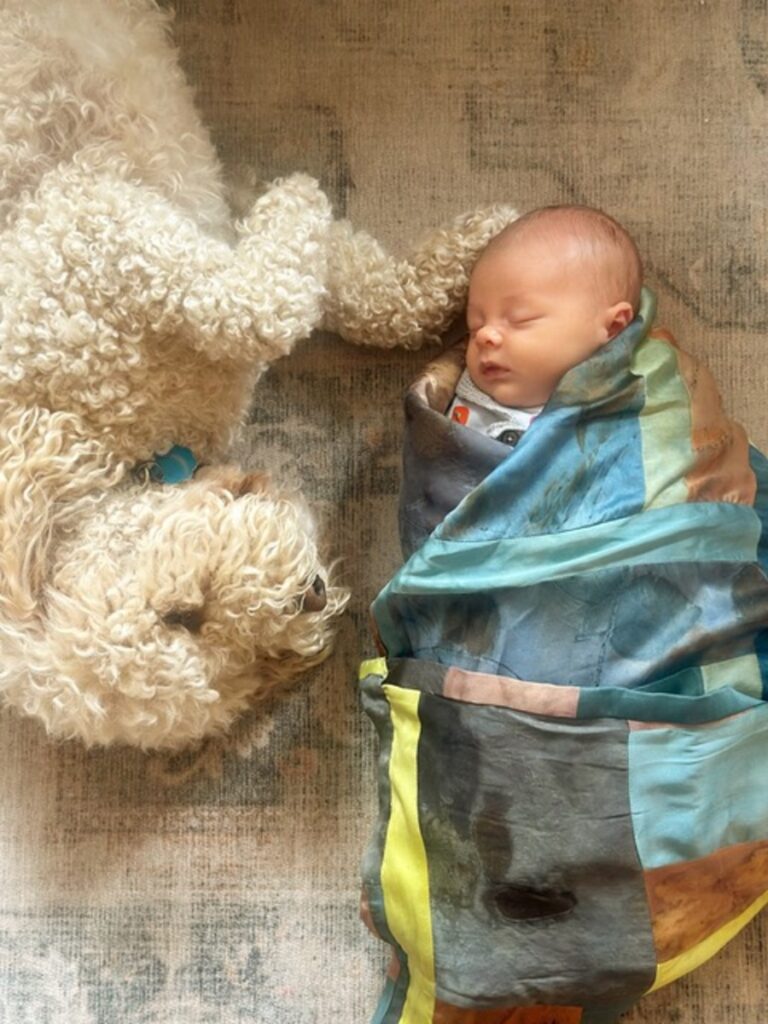
I opened the hospital door and a tsunami of love swept over me as my eyes made contact with a tiny, perfectly formed human. Just a few hours old, baby Otis lay nestled in my daughter’s arms, swaddled tightly with just his head peeking out. His face angelic, creamy and warm, smelling slightly of milk.
Suddenly it struck me that every one of us, even the vilest person on Earth, also started out like this.
This innocent.
This pure.
This defenseless and worthy of love.
Witnessing a baby’s true nature casts a wonderful spell sparking feelings of awe and hope for humanity even in the face of dark times such as these. I could easily continue on waxing on about the wonder I felt at becoming a grandmother and about how it awoke in me a desire to grow into an elder worthy of holding wisdom for the next generation.
But this is an essay about something simpler.
It’s about co-regulation.
And how one small, ancient human act may be a quiet antidote to the overwhelm of modern life.
It was 6 am and I blinked my eyes open from another night of couch surfing in my daughter’s tiny New York apartment. It had been three weeks since my arrival from South Africa.
Headlines of wars, AI revolutions, corporate power struggles, and global economic tension clamored for attention. My phone pinged with notifications of emails, text messages and social media, each with an all too familiar pull competing for my attention.
Outside the window, the howling wind rattled the branches of a nearby tree and the first snowflakes whirled past in a frenzy of white specks. I was experiencing my first ever climate-change-driven bomb cyclone blizzard in New York City.
My flight home to Africa had already been cancelled, and with it came the stress of rearranging appointments and commitments I could no longer keep.
Yet this was also a moment that required something else of me.
Presence.
I pattered into my daughter’s kitchen, made hot lemon water, and took a few conscious breaths. In a matter of minutes my daughter would emerge from her bedroom, exhausted from another night of interrupted sleep, breastfeeding, and tending to her newborn baby.
I heard Otis wail before the creak of the bedroom door. The sleepy duo appeared.
With her breast pump already attached and quietly humming, my daughter looked both radiant and also exhausted- the unmistakable look of someone deeply in love yet longing for the mercy of a few more hours of sleep.
“Are you ready for your shift?” she asked. He’s in “pristine condition” she said referring to his serene state.
I opened my arms and enveloped the tiny newborn into my embrace.
A few minutes later, like a winter squall arriving out of nowhere, Otis’s tiny face flushed bright red and his mouth opened wide with a cry that pierced the quiet morning.
He was upset about something and communicating it in the only language he had.
I changed his diaper and offered a bottle of fresh breast milk. He tried to latch but refused, becoming increasingly distraught. A slight wave of anxiety rose in me too.
Holding him against my chest, I bounced rhythmically on the birthing ball and gently patted his back until the gaseous bubble finally released.
At last Otis accepted the bottle, milk spilling down the sides of his mouth as I dabbed him dry with a soft cloth.
Caring for an infant is a dance of constant attunement- feeding, burping, bouncing, soothing. Each small cue asks for presence.
Eventually baby Otis released into a delicious slumber.
This was when my experiment began.
—–
At birth, newborns are still under construction. They have underdeveloped nervous systems and are still learning how to process sensory information. They do not yet have the ability to self-regulate.
That is why they startle so easily. Arms and legs flinging wide, backs arching, and tiny cries erupt with an intensity of sensations in response to the world around them.
As a breathwork facilitator and yoga nidra instructor, I spend my days with people to help them regulate their nervous systems.
I wondered if I could help Otis regulate his through my own breath.
As he slept on my chest, I noticed how quickly he was breathing.
I quieted my mind and softened my own breath.
Five slow counts in, breathing deep into my belly, expanding like a balloon.
Five slow counts out, releasing back and down into the sofa.
I watched.
I breathed.
I felt.
I waited.
Gradually, his breath slowed too, settling into rhythm with mine.
This became our morning meditation—breathing together in quiet coherence.
As the days continued, I quickly noticed something else.
My own mind wanted to wander and to multi-task. Notifications, emails, headlines, the knee jerk reflex to reach for my phone.
So I guarded this time fiercely.
And something unexpected happened.
As Otis settled, so did I.
Warm waves of calm washed through my body. Oxytocin and dopamine flowed like honey between us. The more present I became, the more grounded I felt.
It was mutual.
—
One morning Otis was especially fussy. Nothing seemed to soothe him.
So I tried another experiment.
Humming.
Like deep breathing, humming stimulates the vagus nerve. This long “wandering” nerve that acts like a superhighway from the brainstem through the heart, lungs, and digestive system, sending signals to our parasympathetic nervous system that its safe to rest-and-digest.
In yogic traditions humming is often used in meditation and pranayama to quiet the mind and create internal harmony.
I held Otis close, his head tucked gently under my chin, and began humming, “OM.”
Then I experimented with making different tones, cycling through all the vowel sounds, noticing how each mouth shape and pitch variation resounded the vibration in different places in my body.
Eventually, I was humming with an abandon that would surely get me kicked out of any respectable choir.
But Otis didn’t mind.
As I rocked back and forth, humming my made-up tune, vibrations moving through my chest, throat, belly, something shifted.
His thrashing arms and legs ceased.
His tiny body relaxed, melting into mine.
His breath slowed.
Within minutes he was sound asleep.
As he softened, so did I.
—
You might ask what happened to the world on fire outside that apartment window?
The wars.
The algorithms.
The endless to-do lists.
For a moment, they waited.
Not because they were unimportant. But because something more fundamental was happening.
Two nervous systems were remembering how to settle together.
It left me wondering:
What might happen if we spent more time co-regulating—not just with babies—but with our partners, friends, siblings and pets?
What if we paused, just for a moment, and put down our devices and our endless striving?
What if we simply sat together, breathing, sensing, listening?
In a world that pulls us into speed, division, and distraction, the simple act of being present with another nervous system may be quietly revolutionary.
Perhaps being a wisdom keeper or an elder may have less to do with having the answers and more to do with having a steady nervous system.
Perhaps the next generation doesn’t only need our wisdom.
Perhaps they need our regulated presence.
And perhaps that presence begins with something as simple as breathing together.
Kathy Stover is a botanical artist and an iRest Yoga Nidra teacher.