A teacher asks her students in the zoom room, “where are we?”
A student answers, “Inside, outside.”
……….
One way to begin with this Koan is to take the “we” or more specifically, the idea of me, or anyone. Who are we? What makes us us? “Where are we” can be also asked as “where am I? Where is ‘i’”?
So, do that. Look for yourself. Right now. Where is “i”?
This may begin a looking in. Perhaps there is even a feeling of going within to find the core, the central seed or spark that begets the rest of the “I” feeling.
………
Where are you? Where are we?
Is there really an inside and outside? If we cannot actually find ourselves inside, then what is outside? Where is outside?
…………..
Like we’ve heard from Matthew about the historical koans, this exchange didn’t happen exactly as written. The teacher, Kathleen, did in fact ask this question of her students in an online yoga nidra session. The student at the time, me, initially just looked about, stopped by the wondering.
…………
Another part of the conversation also included time, “what time is it,” as this particular group of students spanned 4 continents (Africa, Europe, Australia, and North America) and multiple “time” zones. So, feel free to begin your inquiry with this question instead – what time is it? Right now, for me, it’s 8:41 am…
What time is it?
I think either way the inquiry will surface the same unmistakable reality.
“Where are we?”
“What time is it?”
There is a stopping for each of those questions. Then a looking. Then because there is no seeing the answer, there is just opening and just seeing. Inside, outside. Or as Ruth Ozeki says, via her character Jiko, an old Japanese Buddhist nun, “Up, down. What’s the difference?”
Keep looking.
………
I am one of the first to say I prefer meeting in person with people. There is an undeniable feeling when I’m with my people. I regularly quit online courses. My attendance isn’t regular at either of my teacher’s zoom classes. And yet, when I am asked, or when I ask myself “where are we,” the absence of an answer, points to the fallacy of my self-limiting views. If there is no me to be found in here, then why do I think I need to be “in person” with persons in front of me? A little needle to poke a hole in my own assumptions of what “I” need(s), what “I” prefer(s).
………………………
A while back I jotted down a quote from Christian, non-dual mystic, Jim Finley. He says,
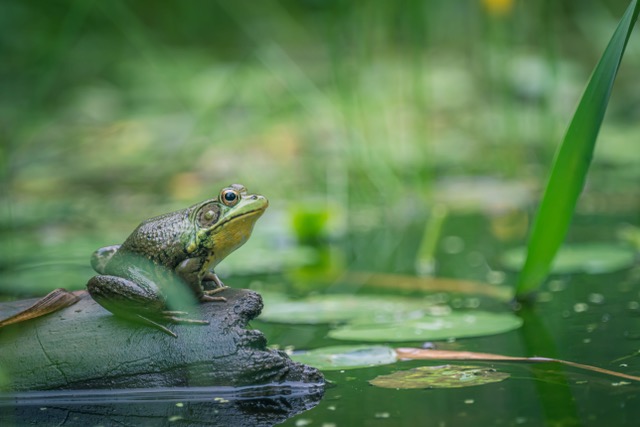
“Or like the Japanese poet Basho, we hear an old frog land in the quiet pond with the solitary splash.”
Can I hear the old frog land in the quiet pond with a solitary splash because of the beautiful nature of poetry, or can I hear it because it is happening, because I’m there when it’s happening, because then is now and there is here?
……….
Even if my thread has become quite thin now with all those words, and you’re no longer sure what it is connected to, trace the subtlety…. And come to rest… here. Letting any remaining walls crumble away. Undefended openness
Lilian Beck is a student of Kathleen Knipp and Zen master Matthew Juksan Sullivan. This talk was delivered during one of Matthew’s classes.