Please take a moment to settle before reading any further. I’d like you to establish a baseline of sensation before engaging with a koan, which we could say is a device intended to challenge our ordinary ways of thinking. After reading it, you will use the barometer of the body to sense its impact.
Simply feel all the sensations of body… and sensations of breath… and sensations of the passing of thoughts and emotions.
What’s here, right now?
——————–
And now the koan:
Lingzao’s Helping
8th century China.
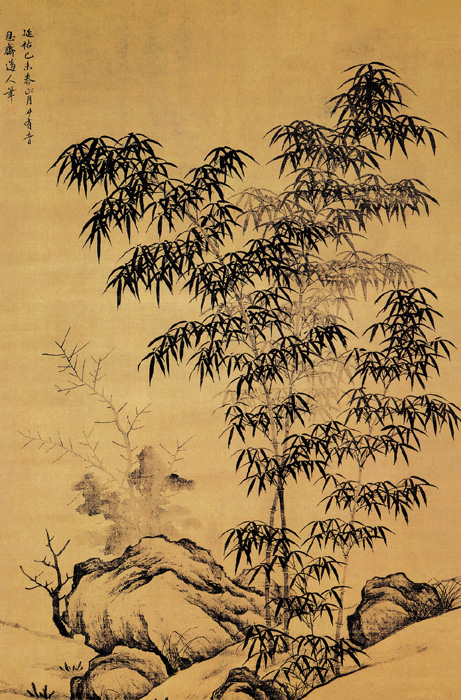
One day, Layman Pang and his daughter Lingzao were out selling bamboo baskets. Coming down off a bridge, the layman stumbled and fell. When Lingzao saw this, she ran to her father’s side and threw herself on the ground.
“What are you doing?” cried the Layman.
“I saw you fall, so I’m helping,” replied Lingzao.
“Luckily no one was looking,” remarked the Layman.
———————
If you had been there… and you had seen your own father stumble and fall to the ground as he was stepping down off a bridge, what would you have done? How would you have reacted? What if it was your ailing spouse? A beloved friend? Your child?
Just notice what arises in you in response.
What does it feel like?
A loved one falls. What happens to us, as the observer?
Is there a subtle movement forward?
An urgency?
Something else?
See if you can catch any feeling of an impulse to assess, to respond.
————————
The Pang family appear in Zen stories as householders, not monks. They are ordinary people of work, family, affection, and friction. Salt-of-the-earth folks. There is a playful element in the family’s interactions.
It is said that the Layman threw all of their possessions into a river, after which he and his daughter supported the family by making and selling bamboo baskets.
When our koan begins, they are perhaps returning from a long day of basket selling.
———————–
Layman Pang stumbles and falls.
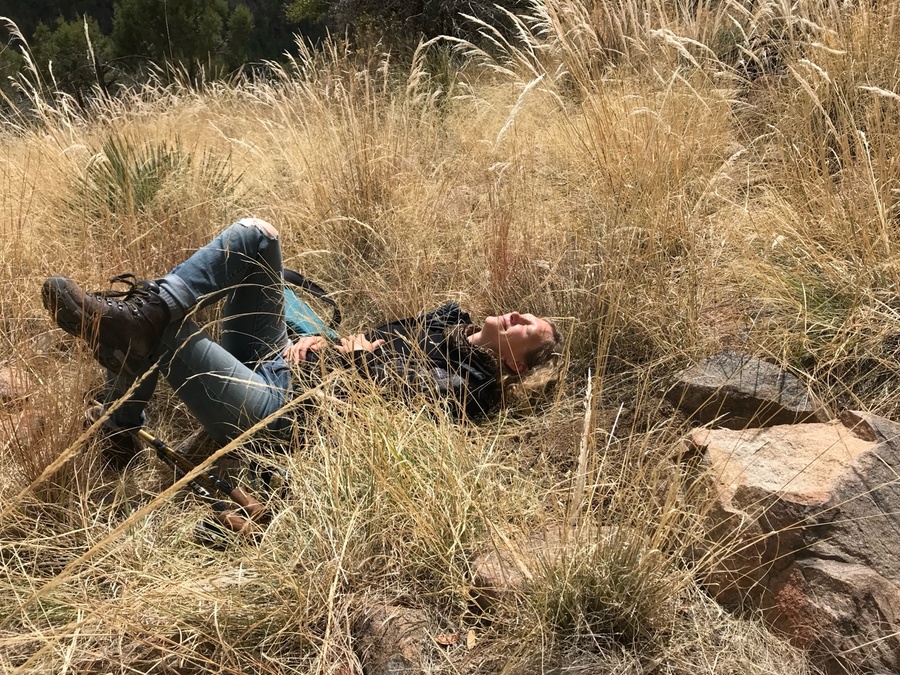
Lingzao rushes over and drops to the ground beside him.
What is happening here?
————————
A fall happens. We might say that, rather than restoring order, she joins him in this moment of disorientation. She enters the same ground.
A similar gesture is found in the Vijñana Bhairava Tantra (Dharana 85 or 87, verse 111), a 7th-century text of Kashmir Shaivism that presents many doorways into direct recognition.
We’re told:
Staggering and dropping swiftly onto the earth, in the moment when agitation settles, the Supreme State is revealed (tr. Knipp).
In some translations the falling is due to exhaustion after a long hike, or spinning until one becomes dizzy (think whirling dervishes)… or perhaps stumbling after crossing a bridge.
Regardless of the catalyst, after the fall, once the excited energy dissipates,
what remains is… This.
———————–
He falls.
She drops beside him.
———————-
But in our koan Lingzhao doesn’t cop to joining her father in his moment of naturally arising revelation.
Instead, when he asks, “What are you doing?”
She says, “I’m helping.”
This is curious.
If she is helping — how is she helping?
If she is not helping — why does she say she is?
What does it mean to help?
——————–
I once asked one of my teachers, a formidable Frenchman named Éric Baret, “You are sitting up there in the front of the room. We’re all sitting here facing you. So, what do you know that I don’t know?”
After a long pause, he opened his eyes and squinted at me. He responded:
“Nothing.”
Nothing.
Nothing to know. No one knowing it. No one not knowing.
Such an answer may sound evasive, but perhaps it points to the heart of the matter.
We are quick to divide the world into helper and helped, knower and not-knower, strong and weak, capable and not capable.
Yet, before those divisions harden, there is simply the moment itself.
———————
Someone falls. Something in us moves.
The wish to act. The wish to make it better.
We are already halfway into a story before we know it.
———————-
In my work as a meditation teacher, I’ve supervised people in the iRest Yoga Nidra training program. One of the requirements is to submit recordings demonstrating open, non-directed listening in a one-on-one exchange.
I worked with a woman once whose first recording was… well, not working at all.
She was capable, trained in many healing modalities… but in the session she offered advice, suggestions, affirmations, techniques.
She wanted to help.
I threw down the “less-is-more” gauntlet and instructed her to try again, this time saying only three things:
“Can you tell me more?”
“What’s that like?”
“How does it feel in your body?”
Nothing else.
She followed the instructions exactly.
When we met for her supervision, she told me that the other person in the recording was her teenage daughter.
She reported that after their dyad her daughter looked at her — with tears in her eyes — and she said, “Mom, you have never ever in my life listened to me before today.”
——————-
Nothing was added. No advice was given. No fixing. No guidance.
And yet something happened.
Or perhaps something had stopped happening.
And in that stopping, there was room — an opening, a gap, and it was felt directly.
——————–
He falls.
She doesn’t reach out a hand.
She doesn’t correct the moment.
She enters it.
——————–
It can be surprisingly difficult not to help. Even when we see that helping may not be what is needed, something arises in us.
A habit. A conditioning. A sense of responsibility.
Or an identity — I am someone who helps.
But Lingzao doesn’t improve the situation. She joins him.
——————-
When someone is down, do we reach out a hand to pull them up? Or do we stay?
When my beloved was dying, I often felt helpless in the face of her suffering. Impotent against her pain.
What I could offer was total, undivided attention. I am here. I am present.
—————–
Lingzao was not helping in a conventional sense.
Ordinarily, when someone falls, we feel “something is wrong,” which elicits intervention.
She doesn’t treat the fall as a problem. She doesn’t step back and respond to him. She drops with him.
Can we meet experience before we organize it?
The moment we decide something shouldn’t be happening… helping begins.
———————
Layman Pang falls.
Lingzao falls.
———————
He says, “Luckily no one was looking.”
Perhaps because, in the end, there is no special event here to be witnessed. No spiritual scene to be praised. A fall happens. A daughter joins her father on the ground. Just an ordinary moment.
Or is it?
Kathleen Knipp is grateful for the guidance and clarity of Zen Master Matthew Juksan Sullivan, who is supporting her koan exploration. This talk was given during one of his classes.
7 Responses
Of course, being a helper and an old ER nurse, I automatically reacted with alarm and offered immediate assistance / intervention.
On reflection, I acknowledged a new ability to stop and chat with that part, the auto-fixer, and to respond to the other’s need and not my own, which requires awareness. Listening and dropping in.
💜
Beautiful, the basis of sponsorship in my work with alcoholics. My dyad work going through iRest training taught me so much.
This is so beautiful and thank you for sharing. It lands with me as I am about to depart to see my beloved aunt in hospice. Kathleen guided me as a mentor 10 years ago when I asked about how to sit with the dying. I am aware of my needs and desires, sensations and emotions. I feel capable of being present, no fixing, simply Being meeting Being. Grateful.
This is so very beautiful. Thank you, dear Kathleen for sharing this. I hope your exploration into the world of koans continues to bring such awareness for you . 🙏🏽❤️
Beautiful reflections, Kathleen! My impulse was to be a “doer” and a “helper.” But, as you so eloquently stated, what if there was nothing to fix. What a rare gift to simply offer presence! Living in South Africa, I encountered a young man who I thought to be less fortunate and wanted to “help”, only to discover his sense of resiliency and presence was far deeper than mine. An awakening moment. Thank you for this thought provoking koan.
Like a lucid dream. What is This? My first koan …Thank you..
Hmmm…First feelings. Ouch, dropped to the ground, eating dirt…I can feel my cheeks and forehead, rocky bumpy hardened clay, over the bridge near that river, all those feet walking. I imagine her there, the daughter, face-down on her hands to protect her face. She’s breathing into the earth, smelling it, vision darkened, there is nothing to see. Only smell, sound, and the overwhelming sensationof her body pressing against the earth in all the ways. Her father, nearby, bossy, stern, not caring that she is here, with him, “helping”, joining…He chides her, we think, that someone might see.
My mother, 92, calls from the hospital, systemic UTI, just as I am writing this. Pocket call, but as long as I have answered, can I renew her library books? I am annoyed. As we talk further, I become agitated, say more about prioritizing and other stern things. I cry out, “What are you doing!?” She answers kinda like this, “I’m trying to help.” I know she’s really upset that she’s there. I am too, for different reasons. And, I am glad no one is looking.